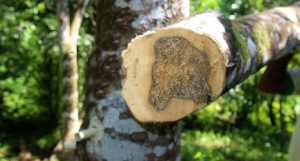
Agar means scent and agar wood actually means scented wood. Aquilaria trees
of family Thymelaecae when get attacked by a mold called Ambrosia
beetle(Dinoplatypus chevrolati) in response to it produce a self defense material
to conceal the damage . Also For defense purpose the resin in wood gradually
increase in its mass, density and changes its colour from pale to yellow, orange,
red, dark brown or black. Due to this mechanism in plant heartwood changes its
colour, texture and develops its characteristics unique scent which is then called
as agarwood . This plant is native to countries of south Asia like Bangladesh,
Thailand, China etc. Though these plants are native to these country it is new
and a matter to study for Nepal. Till date there are 17 species of Aquilaria known
to produce Agarwood. Due to its rarity , high value in market and having suitable
climate for its growth it may be one of the best boon to farmers all over
Nepal.
Importance of Agarwood
Agarwood plant being highly known and paid for its resinous wood it
has some other important benefits as well. It has been widely used as
traditional and ayurvedic medicines. Also They are use for the treatment of
arthritis, asthama, diarrhea etc. These plants are found to have anti –
allergic , anti-inflammtory , anti- microbial , anti- diabetic and antioxidant
properties as well. Due to the aromatic property of agarwood it
is used in makig scents , perfumes, incense sticks and cosmetic
products as well. It China and most of the other countries it is craft in
the form of designs in windows, pillars doors in sacred places like
temples and monasteries. Due to its medicinal ,religious , perfume
properties it make its value high.
Requirement for its cultivation
Agar wood is a forest plant. It generally grows well in hilly areas grater
than 750 meter above the sea level. However, on maintaining optimum
criteria it can be grow on most part of Nepal including terai, inner
terai, mid hills and high hills too. It is found to be growing well in
yellow, red, podzolic, clay soil and sandy soil. It needs a temperature of
about 20 to 35 at an average for its growth but can grow in the places
upto 40 too. It grows well in a forest system rather than as garden tree.
It requires relative humidity ranging from 77-85%. Average rainfall
should be in between 2000 to 4000mm. However, on increasing the
altitude these condition may slightly vary. Looking at the agro
ecological zoning of Nepal it can be grow in tropical , sub- tropical
climates in some cases can grow in mild temperate regions as well. As it
prefers rainwater but not logged condition it is wise to grow the near
watershed in slightly high or slopy land.
Characteristics of agarwood
Agarwood is an evergreen hardy plant. It grows up to 40m high and
spreads about 12m wide. Its trunk is pale to dark brown coloured thin
and smooth with leathery, long and sword- shaped leaves. It has white
flower in clusters bearing egg shaped velvety fruits. Its inner barks and
seed are edible . Trees start flowering at the age of 7-9 years. It starts
producing resins at the age of 20 years however the best resin can be
obtained from infected plant at the age of 50 years. On growing
commercially fungus can be artificially inoculate. It is normally
propagated by seeds which should be do immediately after harvest
as their seeds remain viable for only about 1 months.
Export potentials
Due to the depliction of forests and natural habitat of these plant it
makes them rare and costly. AlsoFirst grade agarwood is one of the most
expensive raw materials in the world . 1 kg of superior and high quality
wood can cost from 20-30 lakhs in market . As the demand of agar
wood is high but its supply is almost negligible in amount Nepal having
perfect growing condition for these plant can be the best and high seller
of agarwood. Also these plant is new to our country processing units can
be rarely found but its and commercial cultivation is seen in 2-3 places.
This can be the plant which surely can bring revolution in agriculture of
near future .